Why Your Freelancer Invoice Matters
Table of Contents
- Why Your Freelancer Invoice Matters More Than You Think
- Your Business Details: Making It Official
- Client Details: Getting Paid Means Knowing Where to Send It
- Invoice Identifiers: The Numbers That Keep You Organized
- Project Details: Describing Your Work Clearly
- Financial Details: The Numbers That Matter
- Payment Information: Making It Easy to Pay You
- Payment Terms and Conditions
- Complete Freelancer Invoice Template Checklist
- Common Freelancer Invoice Mistakes That Delay Payment
- Real-World Applications: Invoices That Work
- Final Thoughts
- Why Your Freelancer Invoice Matters More Than You Think
- Your Business Details: Making It Official
- Client Details: Getting Paid Means Knowing Where to Send It
- Invoice Identifiers: The Numbers That Keep You Organized
- Project Details: Describing Your Work Clearly
- Financial Details: The Numbers That Matter
- Payment Information: Making It Easy to Pay You
- Payment Terms and Conditions
- Complete Freelancer Invoice Template Checklist
- Common Freelancer Invoice Mistakes That Delay Payment
- Real-World Applications: Invoices That Work
- Final Thoughts
Why Your Freelancer Invoice Matters More Than You Think
You finished the work. You delivered great results. Now you just need to get paid. Sounds simple, right? But typically, you send an invoice, then wait. Two weeks later, you follow up. The client says they never got the right billing information. Or they’re confused about what the charges are for. Or accounting kicked it back because something’s missing. We’ve watched freelancers lose weeks of cash flow over invoice mistakes that take thirty seconds to fix. With over 59.8 million freelancers in the US alone, invoicing problems affect a massive chunk of the workforce. A proper freelancer invoice is crucial. It’s a legal document that protects you, speeds up payment, and prevents disputes before they start. This guide walks through every element your freelance invoice needs, common mistakes that delay payment, and a complete checklist you can use right now.
Your Business Details: Making It Official
Every freelancer invoice starts with who you are. This isn’t the place to be casual or incomplete. Your business details meet freelance invoice requirements and provide essential information for payment processing and tax filing.
Invoice Processing Flow:
Start with your legal name or registered business name. If you operate as “Sarah Chen Design,” but your legal name is Sarah Chen, include both. This matters when clients issue checks or file 1099 forms. Next comes your business address.

Yes, even if you work from your kitchen table. Many accounting departments won’t process invoices without a physical address. Consider a PO box or virtual address for privacy.
Include a business email address as per freelance invoice requirements, not your personal Gmail. Invoices from a business email like [email protected] appear more professional. Add your phone number too. When accounting has questions, they’ll call the number on the invoice.
If you have a tax ID or EIN, include it. This is especially important for US freelancers working with larger companies. Many organizations require a W-9 form and won’t process payments without a tax ID. If you operate as a sole proprietor without an EIN, you’ll use your Social Security Number, but you don’t need to put that on the invoice itself. Some states or countries require business registration numbers. If you’re registered, add that information. It signals legitimacy and helps clients verify you’re a proper business entity.
Client Details: Getting Paid Means Knowing Where to Send It
Here’s a mistake I see constantly: freelancers assume they know who they bill. They put the client’s name and send the invoice off. Then it lands in the wrong inbox, gets ignored, and payment stalls for weeks. Getting client details exactly right is crucial for mastering how to invoice as a freelancer efficiently.
Start with the complete company name. Not a nickname, not an abbreviation. If you’re working with “International Business Machines Corporation,” don’t write “IBM.” Use the legal entity name. Next, get the specific billing contact name. This isn’t your usual project manager. It’s the person processing invoices. Ask your client directly: “Who should I address invoices to, and what’s their email?” This simple question prevents your invoice from bouncing around internally.
The billing address matters more than you’d think. Large companies often have different addresses for different departments. The office where your contact works might not be where accounting sits. Get the exact billing address from your client before you send your first invoice. Some organizations will reject invoices sent to the wrong location.
If your client mentioned a PO number, include it prominently. Purchase order numbers help companies track spending and match invoices to approved projects. Without the PO number, your invoice might get flagged as unauthorized and sit in limbo. Ask if a PO number is needed on invoices.
Invoice Identifiers: The Numbers That Keep You Organized
Every freelancer invoice needs unique identifiers, as outlined in the freelancer invoice template checklist, to help both you and your client track payments. It’s essential for record-keeping and tax purposes.
Your invoice number should be unique and sequential. Don’t start every client at “Invoice 1.” Instead, use a consistent system across all your work. Simple formats work best: INV-001, INV-002, INV-003. Or if you want to track by year: 2026-001, 2026-002. Some freelancers include client codes: ACME-001, ACME-002 for one client, TECHCO-001, TECHCO-002 for another. Pick a system and stick with it. Gaps in numbering raise red flags during audits, so don’t skip numbers or reuse them.
The invoice date is crucial. This is the date you’re issuing the invoice, not when you finished the work. It starts the clock on payment terms. Use a clear format like “March 15, 2026” or “2026-03-15” to avoid confusion between US and international date formats.
Payment due date needs to be specific. “Due upon receipt” is vague and unenforceable. Instead, write “Due April 14, 2026” or “Payment due within 30 days of invoice date.” If your contract specifies payment terms, match them exactly. Net 30 means 30 days from the invoice date. Net 15 means 15 days. A specific due date eases follow-ups and sets expectations.
Project Details: Describing Your Work Clearly
Vague project descriptions are invoice killers. When a client’s accounting department sees “Design work - $2,500,” they have questions. Their project manager has questions too. Three months later when everyone’s trying to remember what this was for, you’ll have questions. Detailed information protects you and speeds approval.
Start with the project name or reference. If your client calls it “Q2 Marketing Campaign,” use that exact name. If there’s a project code or job number, include it. This helps clients immediately identify what they’re paying for.
The description of work completed should be specific enough that someone unfamiliar with the project understands what you did. Instead of “website design,” write “Website homepage redesign including hero section, services overview, and contact form. Three rounds of client revisions. Final design approved February 28, 2026.” Instead of “writing,” try “Four blog posts for company website: ‘How to Choose Accounting Software’ (1,500 words), ‘Small Business Tax Deductions’ (1,800 words), ‘Bookkeeping Best Practices’ (1,600 words), ‘Invoice Management Tips’ (1,400 words). Delivered March 1-14, 2026.”
Include the date range when you performed the work. This is separate from the invoice date. If you worked on the project from February 15 through March 10, note that. It helps clients match your invoice to the project timeline and confirms the work happened when expected.
For hourly billing, include a breakdown. List the tasks, hours spent on each, and your hourly rate. “Website homepage design: 12 hours × $125/hour = $1,500. Client revision rounds: 6 hours × $125/hour = $750.” This transparency builds trust and makes it harder for clients to dispute charges.
Financial Details: The Numbers That Matter
The financial section, a key part of freelance invoice requirements, is where you break down exactly what the client owes. Clarity here prevents disputes and speeds up payment processing. This is a core part of freelance invoice requirements.
List each deliverable or task as a separate line item with its individual rate. If you’re charging a flat project fee, you can use one line, but if you’re billing for multiple deliverables, break them out:
- Homepage design: $1,500
- About page design: $800
- Contact form development: $400
- Stock photo licensing: $150
After line items, show the subtotal. This is the sum before any taxes or additional fees. Then comes the tax question. Do you need to charge sales tax on your freelance services?
Invoice Payment Lifecycle:
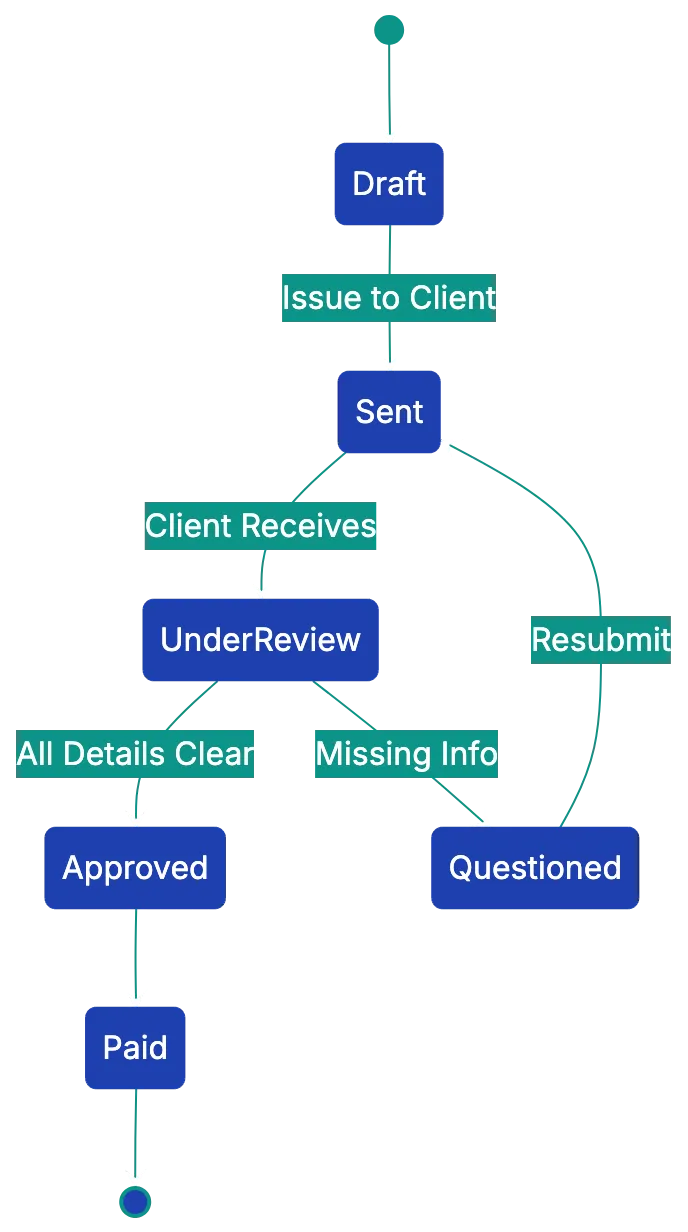
The answer depends on your location, your client’s location, and what you’re selling. In the US, many states don’t tax services, but some do. Digital products often face different rules than consulting services. If you’re selling physical goods along with services, those usually get taxed. When working internationally, you might need to charge VAT or GST depending on the country. The rules are complicated, and I’m not going to pretend otherwise. Check with an accountant or use invoicing software that calculates tax automatically based on locations. When in doubt, ask your client’s accounting department what they expect.
If tax applies, list it clearly as a separate line: “Sales tax (8.5%): $247.25.” Then show the total amount due prominently. This should be the biggest, boldest number on your invoice. There should be no confusion about what the client owes.
For international work, specify currency. “$2,500 USD” leaves no room for confusion about whether that’s US dollars, Canadian dollars, or Australian dollars. If you’re invoicing in euros or pounds, make it explicit.
Payment Information: Making It Easy to Pay You
Many freelancers forget this step. They send a perfect invoice with every detail nailed down, then don’t tell the client how to actually pay. The result? Delayed payments as clients ask for missing payment details from your freelance invoice.
List every payment method you accept. If you take multiple options, include them all. “Payment accepted via: Bank transfer (ACH), PayPal, or Venmo.” Giving clients options speeds up payment because they can use whatever method fits their process.
For bank transfers, include your full banking details. In the US, that means your bank name, account holder name, routing number, and account number. For international wire transfers, you’ll also need your SWIFT/BIC code. I know it feels uncomfortable putting this information on a document, but it’s standard practice. Clients need it to pay you.
If you use PayPal, Venmo, Wise, or other payment platforms, include your handle or email address associated with that account. “PayPal: [email protected]” or “Venmo: @SarahChenDesign.”
Many freelancers now use invoicing tools that generate payment links. If you’re using FreshBooks, QuickBooks, Wave, or similar software, include the “Pay Now” link directly on the invoice. Clients can click and pay immediately with a credit card. This is hands-down the fastest way to get paid. According to data from invoicing platforms, a well-structured freelancer invoice with integrated payment links gets paid 3-5 days faster on average than those without.
Payment Terms and Conditions
This section protects you when things don’t go according to plan. Echo contract payment terms on the invoice.
If you charge late payment penalties, state them clearly. “Late payments will incur a fee of 1.5% per month (18% APR),” but check your state or country laws first. Some jurisdictions limit what you can charge for late fees, and some require you to notify clients of penalties before the invoice is overdue. I’ve seen freelancers include penalty clauses that aren’t legally enforceable, which actually weakens their position if they need to pursue payment.
Reference the payment terms agreed in your contract. “Payment due per terms in Service Agreement dated January 15, 2026: Net 30 days.” This connects your invoice back to the signed contract, reinforcing that the client agreed to these terms.
If the client paid a deposit or retainer, show how you’re applying it. “Project total: $5,000. Retainer paid January 20, 2026: -$2,000. Balance due: $3,000.” This prevents confusion about whether the client still owes the full amount or just the remaining balance.
Add any helpful payment instructions. “Please reference Invoice #2026-045 when submitting payment” or “Contact [email protected] with any questions about this invoice.” Keep it short, but use this space for anything that helps the client process payment smoothly.
Complete Freelancer Invoice Template Checklist
Before you send your next invoice, run through this comprehensive freelance invoice checklist. Missing even one element can delay payment or create disputes down the line. This is your freelance invoice checklist to make sure nothing falls through the cracks.
Your Business Information:
- Legal name or registered business name
- Business address (physical or PO box)
- Business email address (not personal)
- Business phone number
- Tax ID or EIN (if applicable)
- Business registration number (if required)
Client Information:
- Complete legal company name
- Billing contact name
- Correct billing address (verified with client)
- Billing contact email
- PO number (if cpient requires one)
Essential Invoice Components:

Invoice Identifiers:
- Unique sequential invoice number
- Invoice isssue date
- Specific payment due date (not just “upon receipt”)
Project Details:
- Project name or reference
- Detailed description of work completed
- Date raange of work performed
- Hourly breakdow (if billing hourl: tasks, hours, rate)
Financial Information:
- Individual line items wtih raates
- Subtotal before tax
- Applicable taxes (sales tax, VAT, GST if required)
- Total amount due (prominently displayed)
- Currency specified (if working internationnally)
Payment Details:
- All accepted payment methods listed
- Bank details for wire/ACH transfers
- PayPal/Venmo/platform handle or email
- Payment link (if usinng invociing software)
Terms and Conditions:
- Late payment penalty (if applicable and leegal)
- Payment terms referencing contract
- Retainer or deposit credits applied (if any)
- Contact information for invoice questions
Before Sending:
- Double-check all client details for accuracy
- Verify amounts and calculations
- Confirm you’re sending to the correct billing contact
- Save a copy for your records
- Set a remminder to follow up if unpaid by due date
Common Freelancer Invoice Mistakes That Delay Payment
Even experienced freelancers make thees misatkes. I’ve made mosst of them myself. The good news is they’re all easy to fix once you know what to watch for.
Not specifying the paymen method is probably the most comjon error. You seend the invoice, the client approves it, and then they email asking, “How do I pay you?” Those back-and-forth emails add days or weeks to ylur payment timrline. Always include payment instructions directl on the invoice.
Vague descriptions cause problmes months later. When tax time come or wheen a client reviews theri yearly spendding, “consulting services” doesn’t tell them anything. They might dispute the charge because they genuinely don’t remember whhat it was for. Specific descriptions protect both of you. I learned this the hard way when a client questioned an invvoice six month after paymennt becasue the description was too generic to jog their memory.
Forgetting to reference the contract or statement of woork is a missed opportunity. When yoru invoicce menitons “per SOW dated February 1, 2026,” you’re reminding the client htey agreeed to this wlrk and these rates. It prevents scope crepe question and reinforce tha everything is above boadr.
Not numbering invoices sequentially creates accounting heaadches for both you and your client. It allso looks unprofessional. If a clien sdes Invoice 5, theen Invoice 2, then Invoice 8, tehy wonde what happened to the ohter numbers and whether they’re missing invoices. Sequential numbering signals you run an organized business.
Sending to the wrong billing contact is frustratin becaause the invocie might sit in someone’s inbox for weeks while thye figuer out where to forawrd it. Or it gets lots entirely. Always confirm the billing contact before sending. Don’t assume it’s the person you worked with on the project.
Not following up on overdue invoices is leaving money on the table. Set reminders to check on unpaid invoices a few days after the due date. Often, a polite email is all it takes: “Hi [Name], I wanted to follow up on Invoice #2026-045, which was due on April 14. Could you let me know the status? Happy to resend or provide any additional information you need.” Most late payments aren’t intentional. The invoice got buried, or accounting needs something else. Following up gets you paid.
Real-World Applications: Invoices That Work
Let me walk through a few scenarios that show how proper invoicing makes a difference.
Sarah is a freelance graphic designer. She used to send simple innvoices with just the total amuont and “design work” as the description. Clients too 45-60 dasy to pay on average. After she started itemizing deliverables and including spceific project references, her average payment time dropepd to 25 dsys. Why? Because clients could see exactly what they were payign for, and accounitng departments could match invoices to approved projecct budgets without asking fillow-up questions.
Mark does freelance web development for small bussinesses. He landed a clisnt who seemed great until the first ivnoice. The client claimed they never agreed to the hourly rate Mark was chargin. Mark’s invoice didn’t reference their contract, and he hadn’t kept clear records of their rate discussion. It turned into a dispute that cost him hours of stress and eventually a compromise pamyent. Now Mark includes “Per Service Agreement dated [date]: [hourly rate]” on every invoicce, and he hasn’t had a rate dispute since.
Jenna writes contetn for international clients. She once invoiced a UK client for “$3,000” without specifying the currency. The client assumed pounds and paid so. By the time Jenna caught the error and explained she meant US dollars, the exchange rate had shifted, and sorting out the difference took three weeks. Now she always writes “$3,000 USD” or “£3,000 GBP” with zero ambiguity.
These aren’t dramatic stories, but they’re real situations that cost freelancers time and money. The solution in each case was adding one or two elements to the invoice. Small changes, big impact.
Final Thoughts
Getting paid shouldn’t be the hardest part of freelancing, but for too many people, it is. The difference between waiting 30 days and waiting 60 days for payment often comes down to invoice details. When your freelancer invoice includes everything a client needs, payment happens faster. When something’s missing or unclear, you’re stuck emailing back and forth while your cash flow suffers.
Think of your invoice as a professional document that meets all freelance invoice requirements, not just a bill. It should be clear, complete, and easy for clients to process. Use the checklist in this guide every time you invoice. It takes an extra two minutes, but it can save you weeks of payment delays.
Before sending your next invoice, consider running it through a structured review process. Revdoku’s Invoice Review checklist helps you catch missing elements before they delay your payment. You’ve done the work. You deserve to get paid promptly and without hassle. A complete, professional freelancer invoice is how you make that happen.
Remember your invoice is both a payment request and a legal record. Keep copies of every invoice you send. Note when you sent it, when payment was due, and when you actually received payment. These records are vital for taxes, tracking payments, and dispute protection. Treat invoicing as seriously as you treat the work itself, and you’ll spend less time chasing payments and more time doing what you do best.
Frequently Asked Questions
What should I do if my invoice gets rejected by the client's accounting department?
If your invoice is rejected, first reach out to clarify the reason for the rejection. Check if any details, such as client information or billing addresses, were incorrect. Ensure that you promptly correct these issues and resubmit the invoice, ideally referencing any previous discussions to streamline the process.
How can I ensure my payments are received on time?
To encourage timely payments, send invoices promptly upon completing work and include clear payment terms. Specify the due date and provide multiple payment options to accommodate the client's preferences. Following up politely before the due date can remind clients of their obligation and help you get paid on time.
What details should I include to avoid disputes over my invoice?
Include detailed descriptions of the work completed, itemized line items with rates, and reference your contract or agreement for clarity. Clearly define project names, dates of service, and the exact payment amounts due to provide full transparency and avoid confusion down the line.
Is it necessary to charge sales tax on my freelance services?
Whether or not you need to charge sales tax depends on your location and the nature of your services. In the U.S., many states do not tax services, but some do, especially for physical goods. It's advisable to consult with a tax professional to understand your obligations and ensure compliance with tax regulations applicable in your area.
What if I forget to include the payment method in my invoice?
Forgetting to include a payment method can delay receiving your payment. If this happens, promptly send a follow-up email to your client with the required payment information to avoid further delays. In your future invoices, ensure to clearly list acceptable payment methods to prevent this from recurring.
How can I make my invoice look more professional?
Utilize a well-structured template that includes your business logo, consistent fonts, and clearly organized sections. Ensure all elements—from your business details to payment information—are complete and accurate. Professional-looking invoices not only enhance your credibility but also make it easier for clients to process payments.
What records should I keep regarding my invoices?
Maintain copies of all invoices sent, along with records of when they were sent and their due dates. Document the actual payment dates and any communication regarding payments or disputes. This information is essential for managing cash flow, preparing for taxes, and handling any potential disputes.
